

He’d been treating her thyroid for 25 years.
In that time, he’d adjusted her medication repeatedly. Her TSH had moved up and down based on the dose. She had never felt consistently well. Her hair kept thinning. Her weight was stubborn. She was always tired.
When she finally came to a functional medicine clinic, the provider ran a full thyroid panel. Her thyroid peroxidase antibodies were “astronomically high.” She had Hashimoto’s. Her immune system had been attacking her thyroid for, most likely, decades.
No one had ever told her.
Hypothyroidism and Hashimoto’s Are Not the Same Thing
Most patients know they have a thyroid problem. Very few know why their thyroid is underperforming.
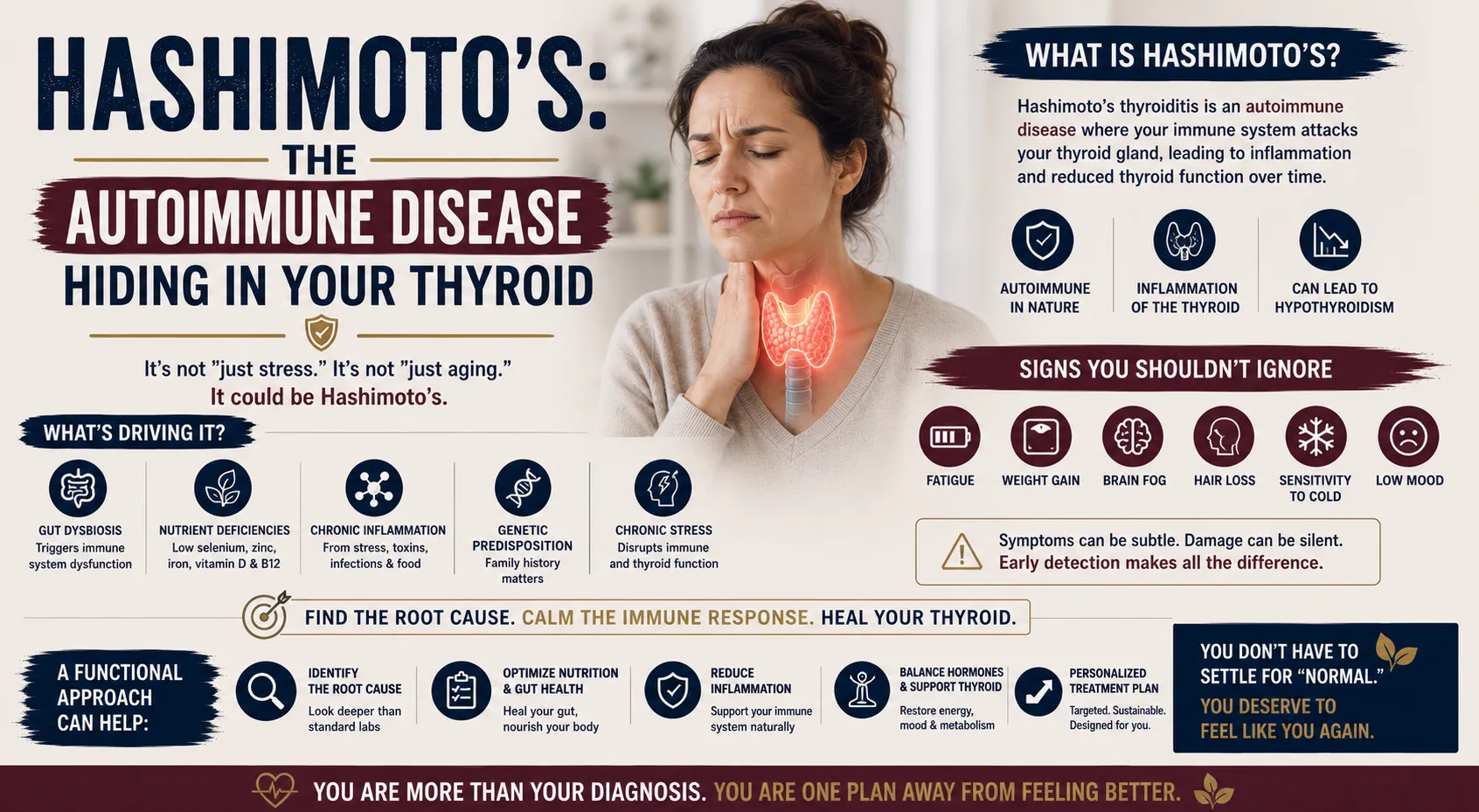
Hypothyroidism is a symptom description: the thyroid isn’t producing enough hormone. In the United States, approximately 90% of hypothyroidism is autoimmune in origin. The cause has a name: Hashimoto’s thyroiditis, also called autoimmune thyroiditis.
In Hashimoto’s, the immune system produces antibodies that target proteins in the thyroid. These antibodies attach to thyroid tissue. Immune cells infiltrate the gland. Over time, they destroy it. The thyroid hormone production capacity decreases as the tissue is damaged. Eventually, hormone levels fall enough to be detected on a test.
But the immune damage starts long before the lab numbers change.
This matters enormously. If you’re managing the hormone deficiency while ignoring the immune attack driving it, you are treating a downstream effect while the upstream cause runs unchecked.
What “Normal Numbers” Actually Mean in Early Hashimoto’s
Here’s the detail that explains why patients go years without a diagnosis.
Thyroid hormone levels can appear fairly normal in early Hashimoto’s, even while immune destruction is already occurring.
The thyroid has reserve capacity. As immune damage takes out some tissue, the remaining tissue compensates, often for years. TSH may fluctuate slightly. T4 may stay in range. The patient feels off, sometimes dramatically off, but nothing shows up on the standard test.
A doctor ordering only TSH will report normal results. They’re not wrong to order TSH. They’re wrong to stop there.
The antibodies are the early warning signal. Thyroid peroxidase (TPO) antibodies and thyroglobulin antibodies appear in the blood during the immune attack phase, often years before thyroid hormone levels shift enough to trigger a hypothyroid diagnosis. These can be measured with a simple blood test. They are not part of the standard panel most patients receive.
Colin Renaud, DC, PA-C describes what he finds regularly: “I have patients where I’ve done lab review and you know we’ve got antibodies in the hundreds and I question them like, have you had these looked at or do you know what this means? And they’re like, no, I’ve had a thyroid problem for 25 years. No one’s ever told me this. They’ve never checked it.”
Twenty-five years. Antibodies through the roof. Never measured.
Why Hashimoto’s Changes the Treatment Conversation
Knowing you have Hashimoto’s rather than just “a thyroid problem” changes what needs to be addressed.
Levothyroxine, the standard thyroid medication, replaces the hormone the damaged thyroid isn’t producing. That’s useful. But it does nothing about the immune attack. It doesn’t reduce antibodies. It doesn’t slow the destruction of thyroid tissue. It manages the downstream hormone deficiency while the immune process continues upstream.
A functional medicine approach to Hashimoto’s asks: why is the immune system attacking the thyroid, and what can be done to address that directly?
This isn’t dismissing medication. Medication has a legitimate role when hormone levels are genuinely low and the patient is symptomatic. But as Colin Renaud, DC, PA-C puts it: “Hashimoto’s is not levothyroxine deficiency. Pathology in the body is not a deficiency of a medication.”
The medication addresses one consequence of the condition. The condition itself requires a different kind of attention.
The Gut-Immune-Thyroid Triangle
The gut is central to the Hashimoto’s story.
The gut houses the majority of the immune system’s tissue. When gut health is compromised, immune regulation is compromised. Intestinal permeability (often called leaky gut) allows proteins that shouldn’t enter the bloodstream to do so, triggering immune responses. In genetically susceptible people, those immune responses can extend to the thyroid.
Gluten is one of the most well-documented dietary triggers for Hashimoto’s. The mechanism involves molecular mimicry: gluten protein sequences structurally resemble thyroid proteins closely enough that immune cells targeting gluten can begin targeting the thyroid.
This is not a fringe theory. It appears in peer-reviewed research. It’s also consistently underutilized in conventional treatment.
A patient had been cycling through medication adjustments for years without meaningful symptom improvement. Her provider encouraged her, repeatedly, to try going gluten-free. She resisted. It seemed too simple. Too disconnected from what she thought of as a “real” thyroid problem.
She eventually agreed, committing to two weeks.
Her antibody levels nearly halved.
She hadn’t changed her medication. She hadn’t added supplements. She had removed one dietary trigger that was fueling the immune attack on her thyroid tissue.
Not every Hashimoto’s patient has gluten as their primary trigger. But for a significant portion, it is a real, measurable, addressable driver, and it’s almost never discussed in a conventional endocrinology appointment.
The Autoimmune Susceptibility Picture
Hashimoto’s rarely appears in complete isolation. It frequently accompanies other autoimmune susceptibility patterns. Managing it well requires understanding the full picture.
Chronic stress is one factor. Sustained stress activates the sympathetic nervous system and drives inflammatory signaling, which can exacerbate autoimmune activity. Nutritional deficiencies, particularly vitamin D, zinc, iron, and selenium, directly affect immune regulation and thyroid function. Environmental toxins can interfere with thyroid hormone synthesis and contribute to autoimmune susceptibility.
The body doesn’t develop Hashimoto’s overnight. It accumulates. Chronic illness doesn’t occur in a sudden event. It builds through years of stressors, deficiencies, dietary triggers, and immune challenges adding up until the system breaks down.
Colin Renaud, DC, PA-C describes chronic disease progression this way: “People that develop Alzheimer’s in their 60s and 70s probably started having an issue when they were 40. Same thing with diabetes. If you’re diagnosed with diabetes at some point in your life, it didn’t switch on overnight. It’s things that you were doing that led to that. So the thyroid is no different.”
That framing is important for patients who feel like Hashimoto’s came out of nowhere. It didn’t. There was a trajectory. Understanding that trajectory is how you address it more completely.
What a Full Evaluation Includes
A complete functional medicine workup for suspected Hashimoto’s includes:
Full thyroid panel: TSH, free T4, free T3, reverse T3, TPO antibodies, thyroglobulin antibodies. Each marker tells a specific part of the story. Reverse T3 matters because the body can produce an inactive form of thyroid hormone under stress that blocks active T3 from working, creating a “functional hypothyroid” state even when other levels look adequate.
Autoimmune susceptibility screening through ANA (anti-nuclear antibody) panels, which can reveal whether other autoimmune processes are active or pending.
Gut health assessment, including microbiome evaluation and intestinal permeability markers, to understand whether the gut is contributing to immune dysregulation.
Nutrient levels: vitamin D, zinc, iron, selenium, B12, and others directly tied to thyroid and immune function.
Dietary history, particularly regarding gluten, dairy, and other potential immune triggers.
This is what a complete picture looks like. It’s not complicated. It just requires ordering more than one lab marker and asking questions that a 10-minute appointment can’t accommodate.
What Patients Can Do
If you have a thyroid diagnosis and you don’t know whether you have Hashimoto’s, ask. The test is a blood draw. TPO antibodies and thyroglobulin antibodies. If your doctor says it doesn’t change the treatment, understand that this is the conventional medical model’s answer, and it’s only accurate if the treatment plan is limited to medication management.
If your antibodies are high, the treatment conversation expands considerably. It includes dietary investigation, gut health, stress management, and nutrient optimization alongside any hormonal support.
“If somebody ever tells you this is the only thing you can do, find a new doctor,” Colin Renaud, DC, PA-C has said. “If somebody is telling you this is the only option, that’s not true.”
Hashimoto’s is not just a thyroid problem. It’s an immune system problem that happens to be centered in the thyroid. Managing it requires addressing both. And the tools to do that are available now, for patients who know to ask for them.
About the Author: This article was written by the clinical education team at Med Matrix, a functional medicine clinic in South Portland, Maine. Med Matrix serves over 3,000 patients with a provider team that specializes in root-cause testing, hormone optimization, and personalized treatment plans.